
Both ablative and fractional lasers use intense light energy to treat skin conditions, but they differ significantly in how they target the tissue, impacting the treatment’s depth, recovery, and results.
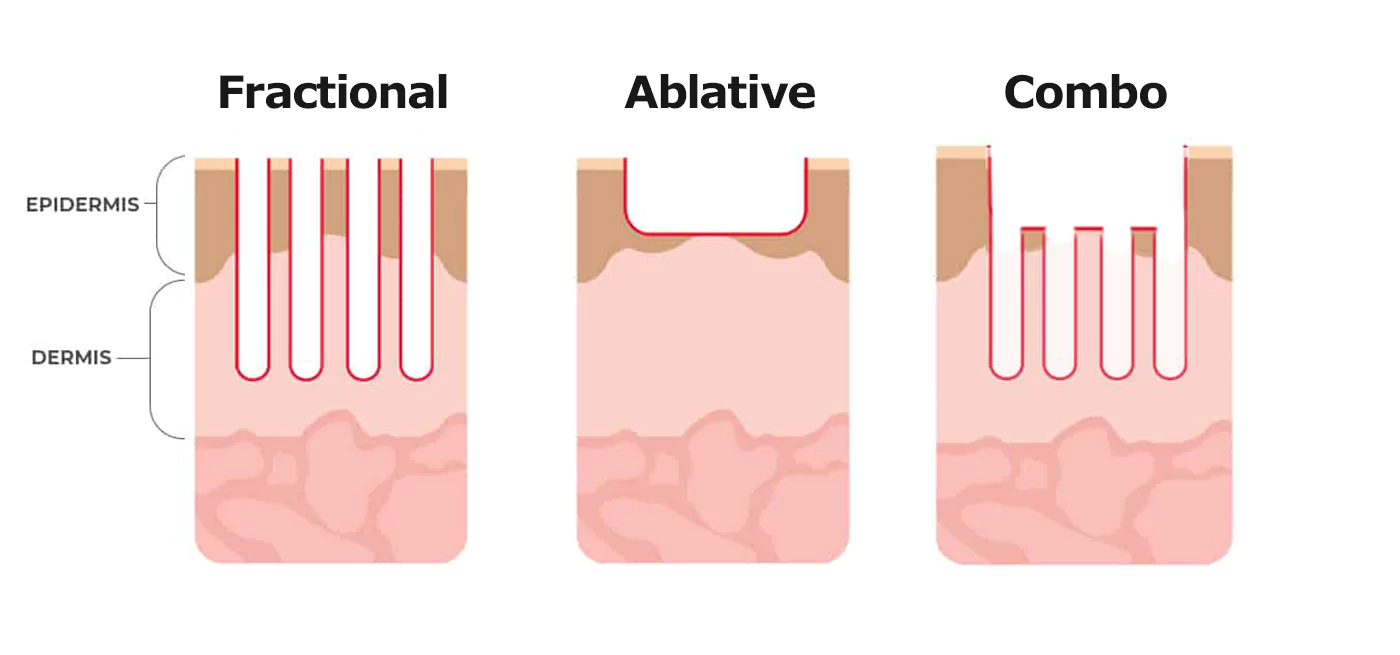
Ablative Mode (Covers 100% Skin)
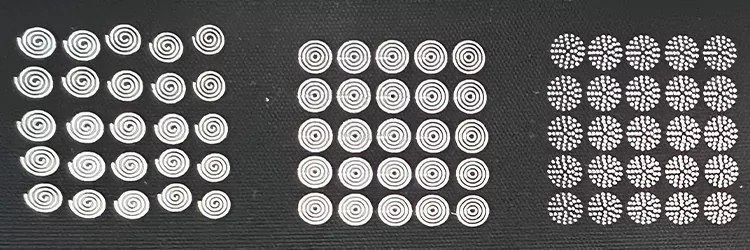
Ablative lasers are the most aggressive and provide the most significant results, often referred to as “full field” resurfacing.
Feature | Description |
|---|---|
Mechanism | Full Epidermal/Dermal Vaporization. The laser beam treats a 100% continuous area of the skin surface, completely vaporizing (ablating) the entire top layer (epidermis) and a controlled portion of the upper dermis. |
Depth | Deepest. Ablative lasers penetrate deeply into the dermal layer, causing significant thermal injury. This deep energy is what stimulates maximum collagen remodeling. |
Recovery / Downtime | Long and Intense (7 to 14 days). Since the entire skin surface is removed, the wound is open. Requires intensive post-care and carries a higher risk of complications (infection, persistent redness). |
Results | Most Dramatic. Excellent for severe sun damage, deep wrinkles, significant scarring, and substantial skin laxity (sagging). |
Typical Use | CO2 and Erbium:YAG lasers in their traditional, full-field mode. |
Fractional Mode (Covers 10%-40% skin)
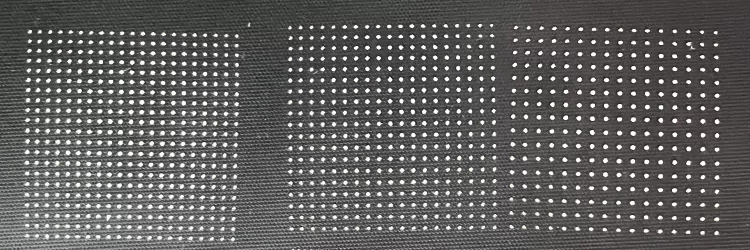
Fractional lasers were developed to achieve ablative-like results with significantly less downtime. They work by creating microscopic zones of injury, leaving most of the skin intact.
Feature | Description |
|---|---|
Mechanism | Micro-Ablation Columns. The laser beam is split into thousands of tiny columns, creating microscopic “wounds” in the skin. The laser treats only 10–40% of the surface area, leaving surrounding skin untouched. |
Depth | Variable (Shallow to Moderate). While some fractional devices can penetrate deep into the dermis, the overall injury to the surface is much less severe than with ablative lasers. |
Recovery / Downtime | Short and Mild (3 to 7 days). Because the skin surrounding each micro-column is intact, healing is rapid. The healthy, surrounding tissue drives quick recovery. |
Results | Moderate to Significant. Excellent for fine lines, uneven pigmentation, mild to moderate wrinkles, and textural improvements. Multiple treatments are often required. |
Typical Use | Fractional CO2, Fractional Erbium:YAG (for ablative fractional). Non-ablative fractional lasers (like Erbium:Glass) are also common for mild issues. |
Summary Comparison
| Feature | Ablative Resurfacing (e.g., Full CO₂) | Fractional Resurfacing (e.g., Fractional CO₂) |
|---|---|---|
| Treated Area | 100% of the skin surface is removed. | 10–40% of the skin surface is treated in columns. |
| Goal | Maximum tightening and removal of deep damage. | Good tightening with faster healing. |
| Downtime | Long (1–2 weeks). | Short (3–7 days). |
| Risk | Higher (Infection, Pigmentation changes). | Lower (Quicker healing due to intact skin). |
| Depth | Definitely Deeper. | Moderate to Deep (Columnar). |
High-Density Fractional vs. Full Ablative
Fractional can heals faster, but ablative can cover 100% skin and get best effect. In this case, you may wonder: If I use fractional mode, but I set it in high-density parameter – with very small dot distance, it will also cover almost 100% skin. In such case, can I get fast heal and best effect at same time?
Good question! While it seems logical that a fractional treatment with, say, 90% density would be the same as a full ablative treatment, the biological reality and the resulting healing process are fundamentally different.
The distinction lies not just in the percentage of skin treated, but in the wound morphology and the presence of intact skin bridges that drive rapid recovery.
Full Ablative
Wound Morphology: A single, continuous, open wound bed is created across the entire treated area. The entire epidermis is vaporized.
Healing Process: The skin must heal through re-epithelialization that starts primarily from the deep adnexal structures (hair follicles, sweat glands) that survived the laser injury, or from the very edges of the treated area.
Provides a continuous, uniform thermal effect across the entire surface and down to the specific target depth. The consistency of the resulting tightening and smoothing is often superior for deep scars or very lax skin because the damage is perfectly even.
High-Density Fractional
Wound Morphology: Thousands of discrete, microscopic columns (Micro-Thermal Zones or MTZs) are created, surrounded by intact, healthy skin.
Healing Process: The intact “bridges” between the columns contain vital, viable epidermal cells (keratinocytes). These cells only have to migrate a microscopic distance—less than a millimeter—to cover the wound columns. This process is often called skip-lesion re-epithelialization.
Even if a fractional laser hits 90% of the skin, the energy profile within the skin remains columnar. It creates a pattern of parallel damage columns. While the columns are close, the tissue between them receives minimal thermal energy.
A fractional laser set to 90% density aims to maximize results while still maintaining the fundamental biological advantage of rapid healing conferred by the intact epidermal bridges. If you increase the fractional density past a certain point (usually around 70-80%), those bridges break down, the rapid healing advantage is lost, and you end up with the recovery profile of a full ablative laser, but potentially with less uniform clinical results.
So, if you want get best effect, you shall choose ablative, if you want get fast healing, you shall choose fractional. You can not get fast healing and best effect at same time by setting a high-density fractional parameter.